AI Inbound Call Handling: How to Stop Losing Customers to Voicemail, Hold Times, and Missed Calls
Category: Inbound Calls | By: Sumit Khanna, founder of Voizematic | Published: | Updated: | Read time: 7 min read
Answer every inbound call, route it naturally, book appointments, and log each conversation without voicemail or hold queues.
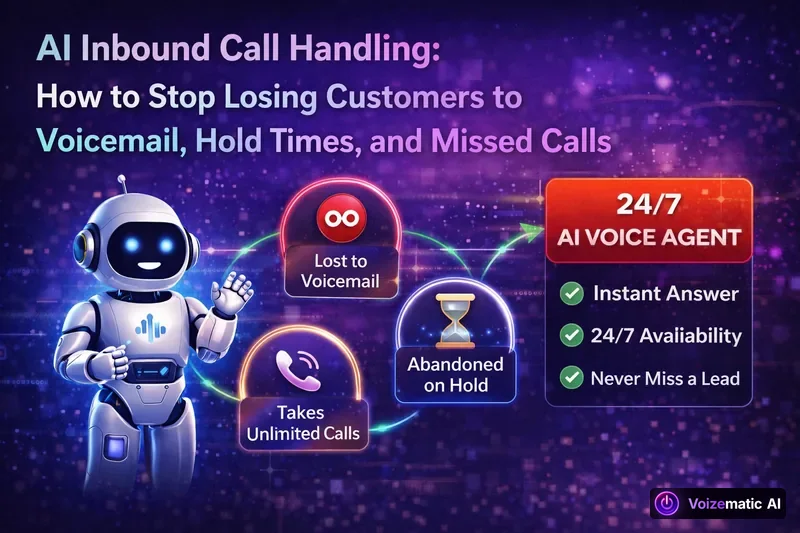
Voizematic AI inbound call handling answers calls on the first ring, routes the caller by intent, books appointments into Google Calendar, and logs every call automatically. It removes the common failure points of missed calls, long hold times, and after-hours voicemail by using an AI voice agent that can speak with the caller, understand the request, and take action during the call.
Why do inbound calls get lost in the first place?
Inbound calls are often missed for simple operational reasons. A member of staff is already speaking to another customer. The phone rings after office hours. The queue gets too long, so callers hang up. Traditional phone systems then push people into menus or voicemail, which adds another step before the caller gets help.
Voizematic takes a different approach. The platform is built for AI voice agents that make and receive phone calls, so the caller is answered immediately rather than placed into a queue. The agent can continue the conversation, understand the request, and either resolve it or route it to the right place.
How does AI inbound call handling work in practice?
Once you have signed up with a Gmail or Google Workspace account, you add money to the wallet and start. There is no separate onboarding. After login, a voice assistant sits at the bottom-right of the panel and helps you navigate the site, open pages, and explain features, so a demo or tutorial is not needed.
For inbound calls, the agent listens to what the caller says, including Hindi and English and code-mixed speech. It can handle both routine and more complex requests. Because the system works on natural language, the caller does not need to press keys or wait through a phone tree.
If the call needs an appointment, the agent can book directly into a connected Google Calendar during the call. If it needs follow-up by email, it can send email through Gmail. If the caller needs a handover, the agent can transfer the call to a human.
What kinds of inbound calls can it handle?
Voizematic supports inbound and outbound calling, including bulk campaigns. For inbound use, that means you can use the same platform for:
- appointment booking
- customer enquiries
- support triage
- billing or account questions
- call transfer to a human agent
- multilingual calls, including mid-call language switching
The platform also supports WhatsApp and Telegram agents alongside voice agents, so the same business can handle conversations across more than one channel.
How does it keep the team informed?
Every call is logged automatically to Google Sheets. That gives your team a clear record of what was asked, what action was taken, and whether the call was resolved, transferred, or booked.
Voizematic also includes a Call Intelligence Engine, which captures sentiment, outcome, and next action per call. It keeps per-caller conversation memory, so the agent can recognise context from earlier interactions when the same caller returns.
For inbound teams, this matters because the call does not end when the phone is put down. The record stays in the workflow, ready for the next person who needs to see it.
How does pricing work for inbound call handling?
Pricing is per connected minute, not per seat, and there is no monthly fee. GST is extra. The voice engine sets the rate, not the plan.
Current pricing is:
- Standard AI Voice: ₹4/min ($0.05), falling to ₹3 as monthly volume grows
- Premium Real-Time AI: ₹9/min ($0.11) flat
Details are available at voizematic.ai/pricing.
Every new account receives ₹150 ($2) of free calling credit. Phone numbers rent for ₹199 ($2) per month.
What should a business expect from inbound AI call handling?
The main benefit is simple: callers are answered quickly, and the call is taken forward instead of being abandoned. That follows from the mechanism itself. There is no voicemail to ignore, no hold queue to sit in, and no menu maze to confuse the caller. The AI can answer, understand, book, log, and transfer in one flow.
Suppose a clinic receives an appointment request after hours. The caller can still speak to the agent, choose a suitable slot, and have the booking written into Google Calendar during the call. Suppose a service business gets a billing enquiry during a busy period. The caller can be handled immediately, then transferred to a human if needed, with the conversation already logged in Google Sheets.
That is the practical use of AI inbound call handling: it keeps the phone line active, the caller informed, and the team working from a complete record rather than from missed messages.
About the author: Sumit Khanna is the founder of Voizematic and builds the platform's voice agents, telephony and billing. He publishes live call demos on the Voizematic YouTube channel.
About Voizematic: Voizematic is an AI voice agent platform that answers and places phone calls for businesses. Agents book Google Calendar appointments live during the call, send Gmail confirmations, run TCPA-compliant outbound campaigns and log every call to Google Sheets. Pricing is per connected minute — Standard from ₹4 ($0.05), Premium ₹9 ($0.11) — with no monthly fee.
← Back to Blog | See Pricing | Start free with ₹150 ($2) credit