AI Voice Agent vs Human Receptionist: The True Cost Comparison for 2026
Category: ROI Analysis | By: Sumit Khanna, founder of Voizematic | Published: | Updated: | Read time: 7 min read
A human receptionist has salary and overhead costs; an AI voice agent is billed by the connected minute and can handle routine calls around the clock.
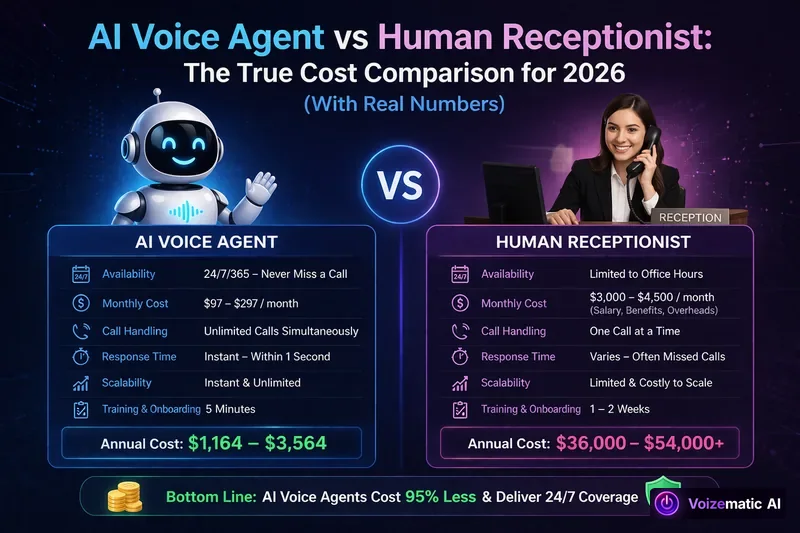
The real cost question is not just salary versus software. It is whether you want to pay for one person’s time, or for a system that can make and receive calls, screen outbound lists, book appointments, log outcomes, and keep working around the clock. Voizematic AI is built for that model, with billing per connected minute and no monthly fee.
What does a human receptionist actually cost?
A receptionist or outbound caller is never just a salary line. Once you add employer taxes, benefits, paid leave, training, supervision, turnover and the time lost when calls arrive while someone is busy, the total cost becomes harder to control. A person can only handle one conversation at a time. They need breaks. They can be absent. They also need management and process support.
That does not mean a human is the wrong choice in every setting. It means the cost is broader than wages alone. If your operation depends on phones being answered at all hours, the labour model has built-in limits.
How does an AI voice agent change the cost model?
Voizematic AI charges for connected call time, not per seat. You add money to a wallet and start. The rate depends on the voice engine, not on a plan tier. Standard AI Voice is ₹4 per minute, falling to ₹3 as monthly volume grows. Premium Real-Time AI is ₹9 per minute flat. GST is extra. Full pricing is listed at voizematic.ai/pricing.
That structure matters because it links spend directly to usage. If you have more calls, you use more minutes. If volume is lighter, you use less. There is no separate onboarding, and users can sign up with any Gmail or Google Workspace account. After login, a voice assistant sits at the bottom-right of the panel and helps navigate the site, so there is no demo or tutorial to arrange first.
What work can the AI handle during a call?
Voizematic AI is not only for simple call answering. It can make and receive phone calls, including bulk campaigns. It supports both inbound and outbound calling. It can also send email through Gmail and book appointments into a connected Google Calendar while the call is still in progress.
That means a caller does not need to be told to wait for a follow-up message in order to complete routine tasks. The agent can check availability, place the booking, and send the confirmation in the same interaction. For many businesses, that is the main operational advantage: fewer hand-offs, less delay, and a clearer next step for the caller.
How does Voizematic handle outbound calling safely?
Before outbound dials, Voizematic runs TCPA/DNC screening against FTC and state lists. That is important for any business that uses phone outreach at scale, because it adds a compliance layer before the call is placed.
The platform also logs every call to Google Sheets, which gives teams a simple record of activity. On top of that, the Call Intelligence Engine captures sentiment, outcome, and next action for each call. So the system does not just place calls. It also creates a usable trail for follow-up and review.
What if your callers speak Hindi, English, or both?
Voizematic agents speak and understand Hindi and English, including code-mixed speech. They also support 50+ languages with mid-call switching. That helps when a caller changes language partway through a conversation, which is common in day-to-day business use.
The agents also keep per-caller conversation memory. So when a contact comes back later, the agent can continue with context rather than starting from zero. If a call needs a person, the agent can transfer it to a human.
Is an AI voice agent a replacement for every human role?
No. Some calls still need a person, especially when judgement, sensitive handling, or unusual situations are involved. The practical value of an AI voice agent is that it can take over routine, repeatable call work and stay available when staff are offline.
That includes after-hours inbound calls, outbound follow-ups, bulk calling, appointment booking, and basic qualification. It also includes WhatsApp and Telegram agents alongside voice agents, which gives teams more than one channel for routine contact.
For many businesses, the question is not whether to remove people from the process. It is how to stop paying humans to do repetitive call work that a voice agent can already manage in a more controlled way.
What should a business budget for getting started?
Every new account receives ₹150 of free calling credit. Phone numbers rent for ₹199 per month. From there, you add wallet balance and pay per connected minute as calls are made.
That makes the entry point straightforward: no seat licences, no monthly platform fee, and no separate onboarding. The spend follows actual call activity. If your calling volume rises, the usage rises with it. If you want to compare exactly how the engine is priced, use the live pricing page.
So the true comparison is simple. A human receptionist brings judgement and flexibility, but also fixed employment cost and limited availability. Voizematic AI gives you phone automation that can call, receive, book, send email, screen outbound lists, log outcomes, and switch languages, with billing tied to use rather than headcount.
About the author: Sumit Khanna is the founder of Voizematic and builds the platform's voice agents, telephony and billing. He publishes live call demos on the Voizematic YouTube channel.
About Voizematic: Voizematic is an AI voice agent platform that answers and places phone calls for businesses. Agents book Google Calendar appointments live during the call, send Gmail confirmations, run TCPA-compliant outbound campaigns and log every call to Google Sheets. Pricing is per connected minute — Standard from ₹4 ($0.05), Premium ₹9 ($0.11) — with no monthly fee.
← Back to Blog | See Pricing | Start free with ₹150 ($2) credit