Personalized AI Calling + Business-Specific Call Intelligence: Why Generic AI Dialers Leave Money on the Table
Category: Analytics & Insights | By: Sumit Khanna, founder of Voizematic | Published: | Updated: | Read time: 7 min read
Voizematic greets contacts by name and measures each call against the outcomes that matter to your business, not generic averages.
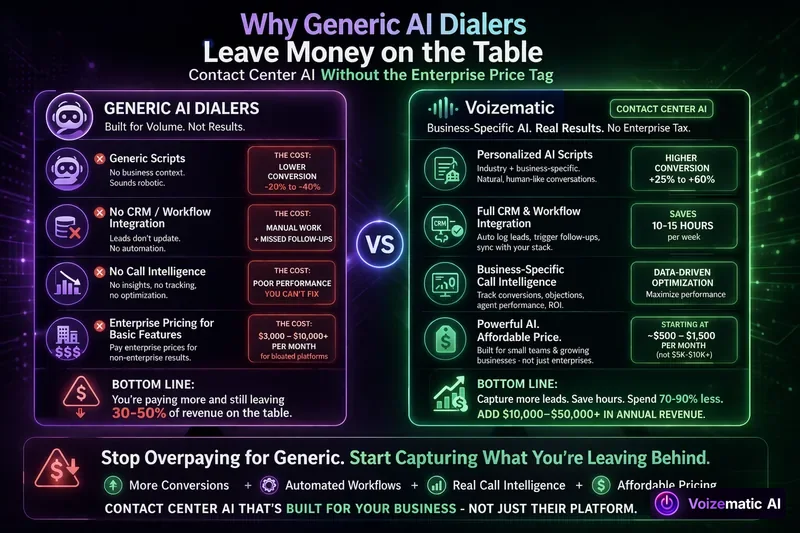
There are two broad approaches to AI calling. One places calls and records a basic outcome. The other treats each call as a real conversation, using contact history and business-specific metrics to guide the interaction and measure what happened. Voizematic is built for the second approach, so you can run calls that feel personal and review them in a way that is useful for your own operation.
How does personalised AI calling work?
Voizematic AI is a platform for building and running AI voice agents that make and receive phone calls. After login, a voice assistant sits at the bottom-right of the panel and helps you move around the product, open pages, and understand features. That means you do not need a separate demo or tutorial to get started.
Once you add money to your wallet, you can begin. Billing is per connected minute, not per seat. Every new account receives ₹150 of free calling credit, and phone numbers rent for ₹199 per month.
During a call, the agent can use the information you have already connected to the account. It can greet a contact by name, refer to past interactions, and continue the conversation in a way that matches the context. The point is not to sound clever. The point is to avoid the flat, generic opening that makes a call feel automated.
What can the agent remember during the call?
Voizematic agents can keep per-caller conversation memory. That means the agent can use details from earlier interactions when the same person calls again, or when you call them back later. If someone has already asked a question, raised a concern, or shown interest in a specific topic, the agent does not need to start from zero.
This matters because phone conversations often fail when they force the caller to repeat themselves. With memory in place, the agent can stay on the thread of the discussion and move towards the next step more naturally.
The same call can also switch between Hindi and English, including code-mixed speech. Voizematic supports 50+ languages with mid-call switching, so the agent can adapt when the person on the line changes language part-way through the conversation.
What does business-specific call intelligence mean?
Generic logs only tell you that a call happened, how long it lasted, and whether it was answered. That is useful, but not enough. Voizematic includes a Call Intelligence Engine that records sentiment, outcome, and the next action for each call.
This gives you a clearer view of what to do with the call after it ends. For example, you can see whether the person was interested, neutral, or unwilling to continue, what the outcome was, and what follow-up should happen next. Because every call is logged to Google Sheets, your team can review this data in a format that is easy to sort, filter, and share.
The important point is that the engine is not limited to a single generic definition of success. You can shape the way you use the data around your own process. Suppose a clinic cares about appointment booking and reminder calls. Suppose a sales team cares about whether the lead agreed to a follow-up. Suppose an operations team cares about whether a transfer to a human agent was needed. The useful signal is different in each case, and the call intelligence should reflect that.
Can the agent take action during the call?
Yes. Voizematic agents can book appointments into a connected Google Calendar during the call, and they can send email through Gmail. That means the call does not end with only a note. The agent can move the conversation towards a concrete action while the person is still on the line.
Voizematic also supports both inbound and outbound calling, including bulk campaigns. You can use it for incoming enquiries, follow-ups, reminders, and scheduled outreach. If a conversation needs a handover, the agent can transfer the call to a human.
For outbound work, Voizematic runs TCPA/DNC screening before dialling, using FTC and state lists. That screening step is there to reduce the risk of calling people who should not be contacted. It is part of how the platform handles outbound calling before the call ever starts.
How do voice agents fit with WhatsApp and Telegram?
Voizematic also has WhatsApp and Telegram agents alongside the voice agents. This gives you one place to run conversations across channels, rather than treating voice as a separate island.
For many teams, that matters because not every contact is best handled in the same way. Some people prefer a call, some respond better to a message, and some need a mix of both. Voizematic lets you work across these channels without changing the basic platform.
What does pricing look like?
Pricing is based on connected minutes, with no monthly fee and GST extra. Plans no longer set the rate; the voice engine does.
- Standard AI Voice: ₹4 per minute, falling to ₹3 as monthly volume grows
- Premium Real-Time AI: ₹9 per minute, flat
Full details are available at voizematic.ai/pricing.
If you want a platform that can speak to people naturally, remember context, handle Hindi and English, book appointments, send email, and show you meaningful call outcomes, Voizematic is built for that workflow. If you only need a basic dialler, generic logs may be enough. If you want the call itself and the follow-up data to support your business process, personalised calling and business-specific intelligence are the stronger fit.
About the author: Sumit Khanna is the founder of Voizematic and builds the platform's voice agents, telephony and billing. He publishes live call demos on the Voizematic YouTube channel.
About Voizematic: Voizematic is an AI voice agent platform that answers and places phone calls for businesses. Agents book Google Calendar appointments live during the call, send Gmail confirmations, run TCPA-compliant outbound campaigns and log every call to Google Sheets. Pricing is per connected minute — Standard from ₹4 ($0.05), Premium ₹9 ($0.11) — with no monthly fee.
← Back to Blog | See Pricing | Start free with ₹150 ($2) credit